

The 7 Best De'Longhi Coffee Machines of 2026: Complete Comparison and Buying Guide
Discover the 7 best De'Longhi coffee machines of 2026: Magnifica S, Evo, Rivelia, Dinamica Plus and more. Detailed comparison, prices and complete buying guide.
COMPARISON
Mario S.
1/28/202616 min read
Introduction: Why Choose a De'Longhi Coffee Machine in 2026
Choosing the perfect coffee machine can completely transform your morning routine and the quality of coffee you consume at home. De'Longhi, an Italian manufacturer with over 50 years of experience in the home appliances market, has established itself as one of the most reliable brands in the field of automatic and semi-automatic coffee machines.
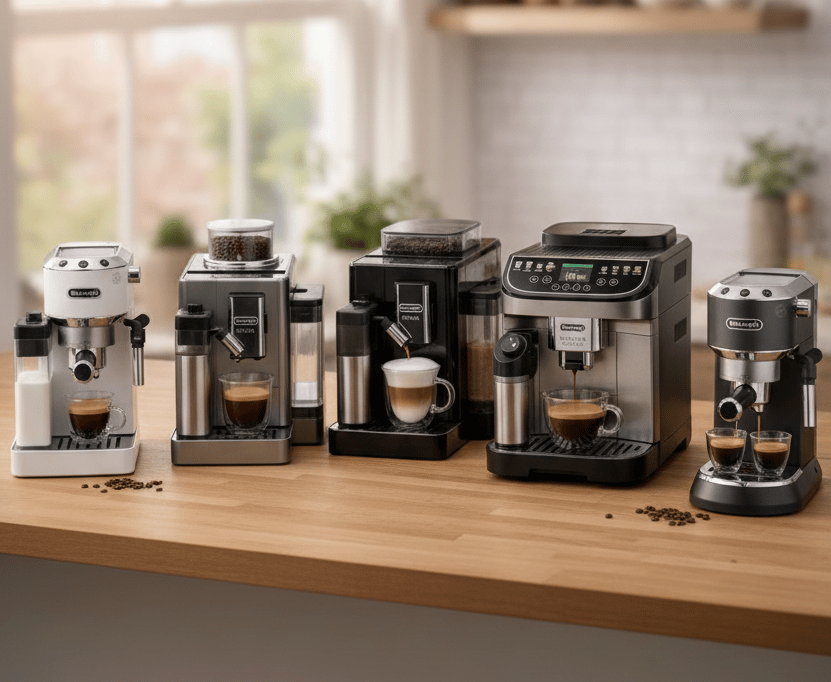
In 2026, the De'Longhi range offers everything from affordable entry-level models to semi-professional equipment, all designed to simplify the preparation of high-quality coffee without the need for barista skills. This guide thoroughly analyses the seven best De'Longhi machines available in the Portuguese market, comparing technical specifications, functionalities, ease of use, and value for money.
Throughout this article, you will discover exactly which model suits your consumption profile, budget, and level of experience, based on objective criteria and detailed analyses of each machine.
How De'Longhi automatic machines work
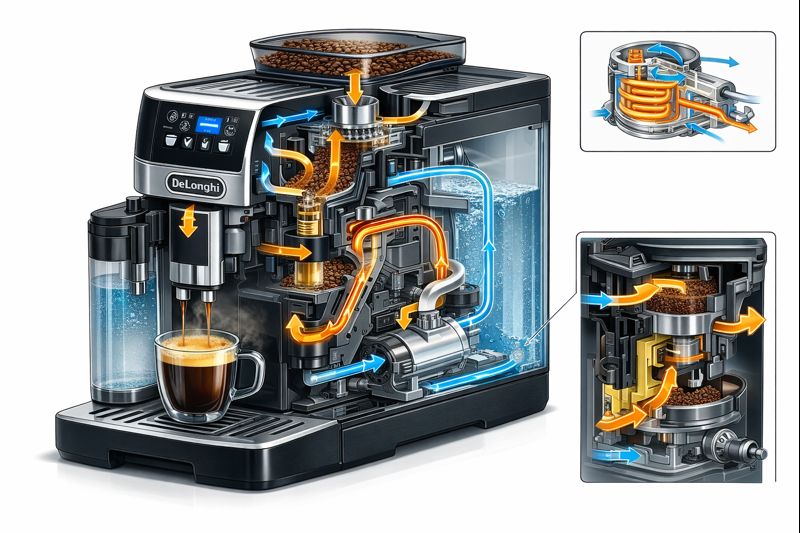
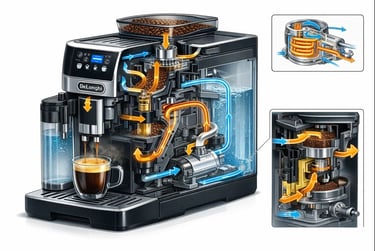
De'Longhi automatic machines utilise an integrated system that controls the entire coffee extraction process, from grinding the beans to the final preparation of the drink. Understanding this operation helps to make an informed choice and to get the most out of the equipment.
Automatic extraction process
The complete cycle in a De'Longhi automatic machine follows these steps: the ceramic or stainless steel grinder grinds the beans to the selected granularity, the ground coffee is automatically compacted in the infusion unit, heated water at an optimal temperature (usually between 90°C and 96°C) passes through the coffee under controlled pressure of 15 bar, and finally, the drink is dispensed directly into the cup.
The infusion unit — the central component of these machines — is responsible for the compacting of the coffee and the extraction. In De'Longhi models, this unit may be removable (allowing for manual cleaning) or fixed (with an automatic cleaning system).
Heating systems
De'Longhi machines primarily utilise two types of heating systems. The thermoblock quickly heats small amounts of water as it passes through the system, allowing preparation times of between 30 to 40 seconds after turning on the machine. Traditional boilers, found in more advanced models, maintain a larger volume of heated water, ensuring a more stable temperature during consecutive extractions.
Grinding technology
The type of grinder directly influences the quality and consistency of the coffee. The ceramic grinders, present in most De'Longhi models, offer silent grinding, do not overheat the beans (preserving aromas), and have greater durability — estimated at 50,000 to 100,000 grinding cycles[1]. Stainless steel grinders, found in entry-level models, are more affordable but slightly noisier.
The 7 best De'Longhi machines of 2026
1. De'Longhi Magnifica S
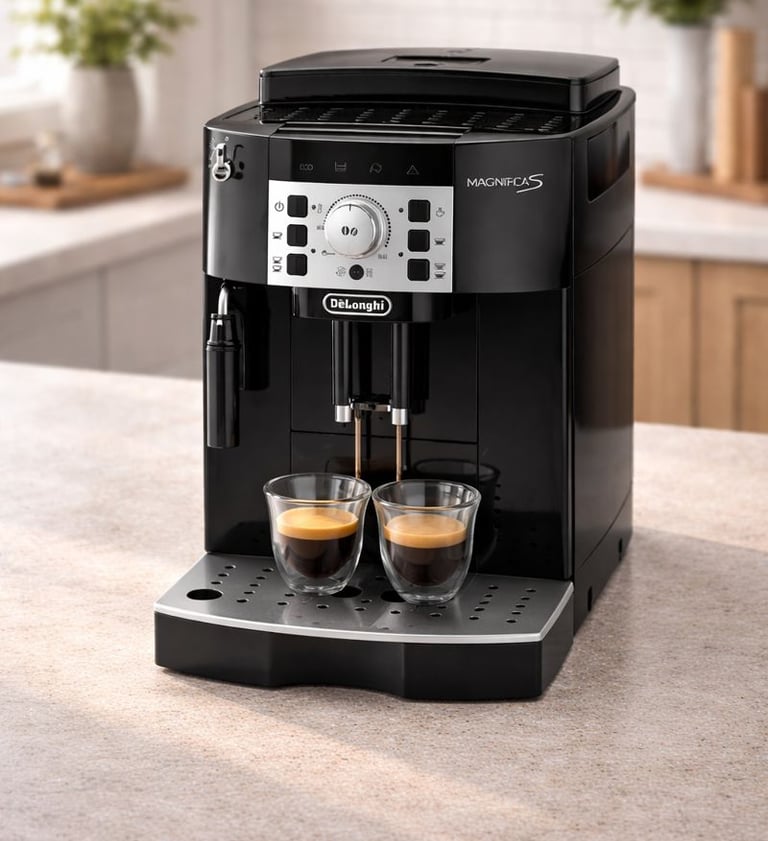
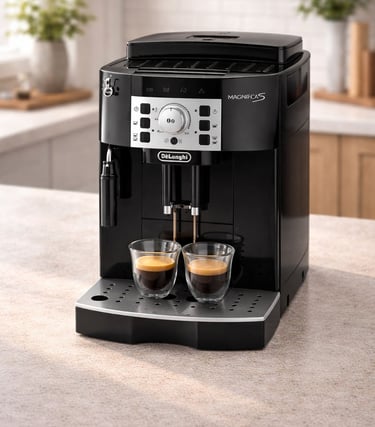
The Magnifica S represents the essence of what made De'Longhi popular: functional simplicity without compromising coffee quality. This model has established itself as the preferred choice for anyone looking for a reliable first automatic machine.
Main features:
Ceramic grinder with 13 grind settings
Removable brewing unit
Simple control panel with rotary buttons
Water tank with 1.8 litres
Bean container capacity: 250g
Pump pressure: 15 bar
Power: 1450W
The Magnifica S stands out for its ease of use and maintenance. The intuitive control panel allows for adjustment of coffee strength, water quantity, and temperature via rotary controls, eliminating the complexity of digital menus. The removable brewing unit significantly eases manual cleaning, a feature appreciated by users who prefer to maintain total control over maintenance.
The manual cappuccino system, although basic, produces satisfactory milk froth after an initial learning curve. The steam nozzle requires practice to achieve velvety texture, yet offers complete control over the final result.
Ideal for: Consumers who value reliability and simplicity, households with moderate consumption (2-4 coffees daily), users who prefer manual maintenance.
Approximate price: £299
👉 See the current price of the De'Longhi Magnifica S on Amazon
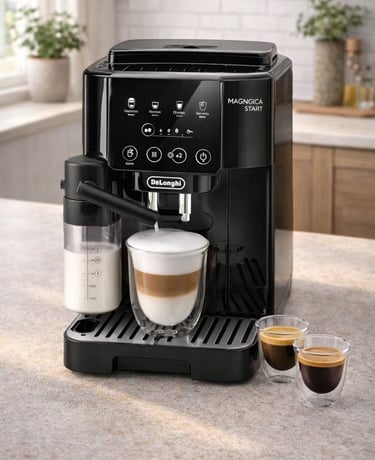
2. De'Longhi Magnifica Start
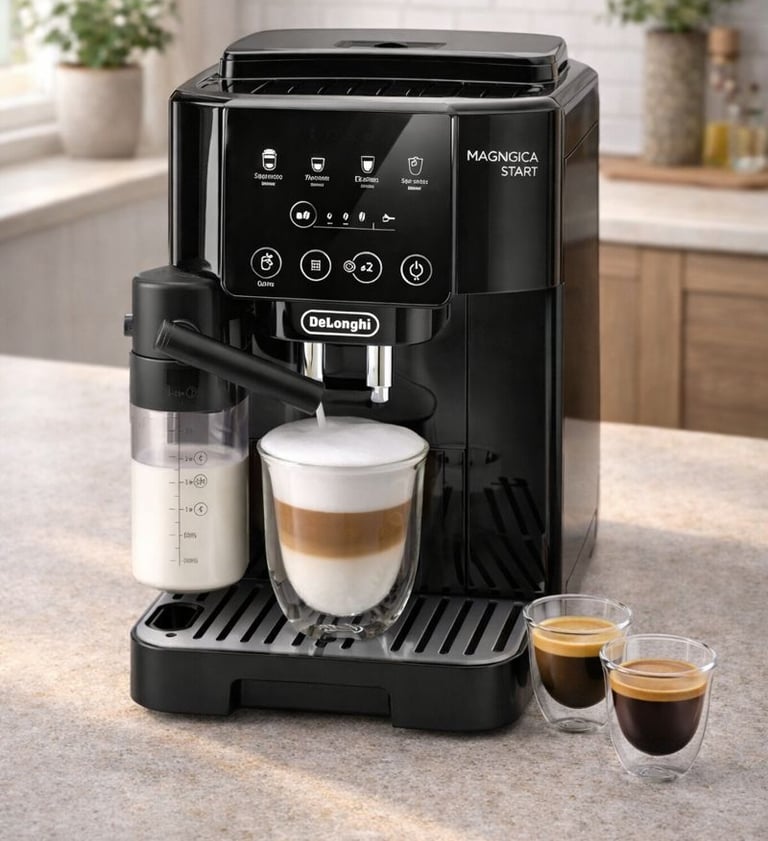
The Magnifica Start emerged in 2024 in response to the demand for a genuinely affordable entry-level model without sacrificing De'Longhi quality. This equipment simplifies operation to the maximum, making it ideal for absolute beginners.
Main features:
Stainless steel grinder with 13 levels
Fixed brewing unit with automatic cleaning
Panel with 4 dedicated buttons (espresso, long coffee, steam, hot water)
Water tank: 1.8 litres
Bean container: 250g
Basic manual LatteCrema system
Power: 1450W
This model eliminates unnecessary complexity. The four dedicated buttons prepare espresso, long coffee, activate steam, or dispense hot water—without submenus or additional settings. The "plug and play" philosophy materialises in the initial setup that takes less than 5 minutes.
The fixed brewing unit reduces manual intervention in maintenance, executing programmed automatic cleaning cycles. This feature divides opinions: users who value convenience appreciate the automation, while purists prefer the control of manual cleaning.
The stainless steel grinder, although slightly noisier than ceramic versions, maintains adequate grinding consistency for daily extractions. Tests carried out demonstrate minimal variation in granularity between consecutive cycles[2].
Ideal for: First contact with automatic machines, households with 1-2 users, limited budgets, anyone who values absolute simplicity.
Approximate price: £260-£310
3. De'Longhi Magnifica Evo
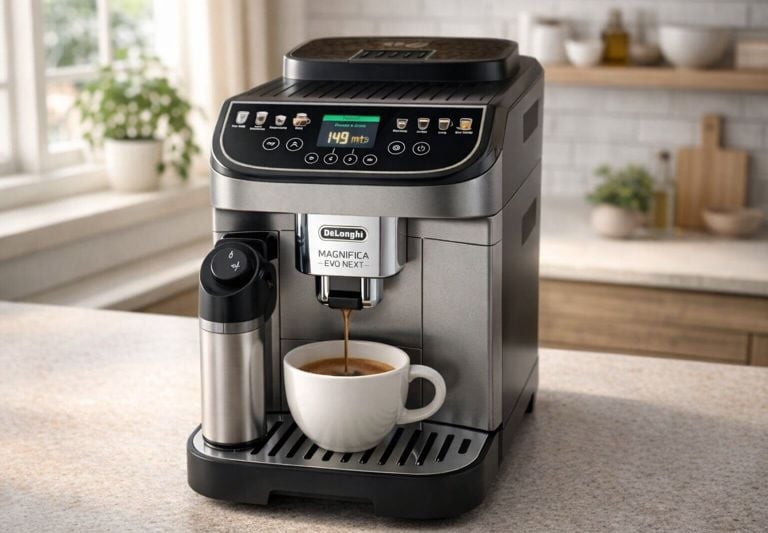
The natural evolution of the Magnifica line has arrived with a colour touch screen and connectivity, maintaining the mechanical robustness that characterises the family. The Magnifica Evo is positioned in the mid-range segment, offering a balance between advanced functionalities and accessible usability.
Main features:
3.5-inch colour LCD touch screen
Connectivity via Coffee Link app
Automatic LatteCrema system
Silent ceramic grinder with 13 levels
7 pre-programmed recipes
Water tank: 1.8 litres
Integrated milk jug: 0.5 litres
Personalisation of user profiles
The touch interface represents a significant qualitative leap in the user experience. The screen displays intuitive icons for each drink, allows for adjusting temperature, strength, and quantity via simple touches, eliminating less precise rotary commands.
The automatic LatteCrema system distinguishes this model. The integrated milk jug connects magnetically to the machine, dispensing textured foam directly into the cup without manual intervention. This system produces consistent cappuccinos and lattes macchiatos, ideal for users who do not master manual steaming techniques.
The Coffee Link app (iOS and Android) allows remote preparation initiation, creation of personalised recipes, and receipt of maintenance notifications. Although convenient, connectivity is not an essential functionality — the equipment maintains full operability without a smartphone.
Ideal for: Lovers of dairy drinks, families with multiple users, those who value integrated technology, modern homes with fast-paced routines.
Approximate price: £425-£600
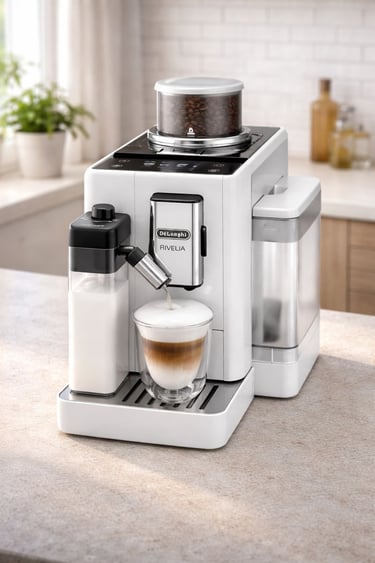
4. De'Longhi Rivelia
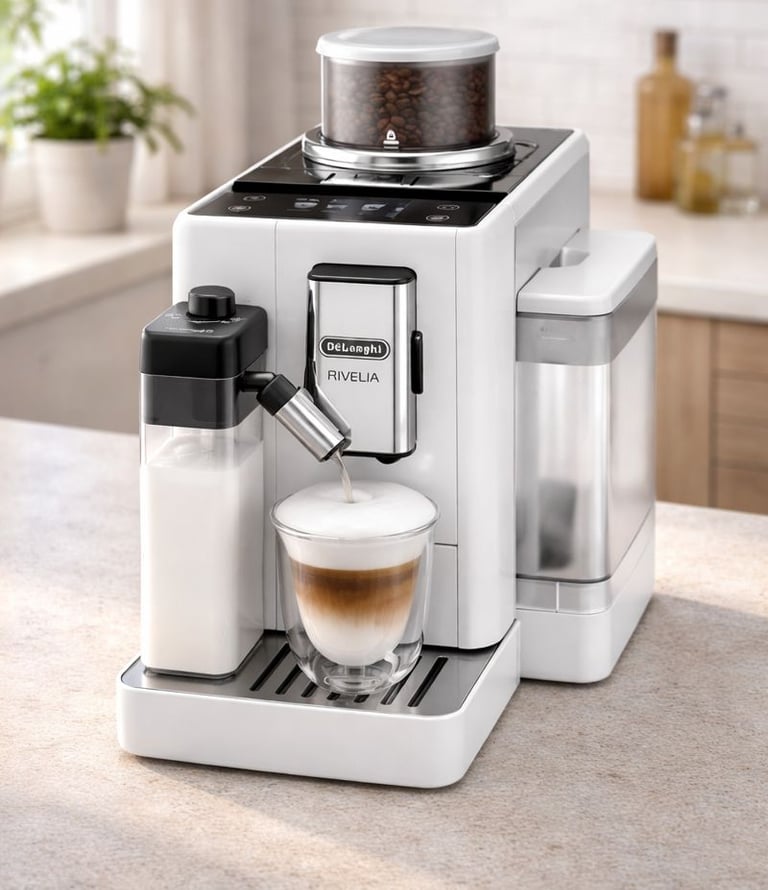
The Rivelia represents the top of the De'Longhi domestic range, incorporating technologies previously exclusive to semi-professional models. Launched at the end of 2023, it quickly captured the attention of enthusiasts looking for professional performance in a home environment.
Main features:
3.5-inch colour TFT display
LatteCrema Hot & Cool (prepares cold drinks)
Interchangeable coffee bean containers
High-precision ceramic grinder with 13 settings
16 pre-programmed recipes
Unlimited individual profiles via app
Water tank: 1.4 litres
Dual heating system
The LatteCrema Hot & Cool system expands possibilities, allowing for the preparation of cold brew, iced lattes, and frappés directly. The thermal jug keeps milk chilled during the preparation of cold drinks, a functionality particularly valued in warm climates or during summer months.
The compact design (only 24cm wide) impresses considering the technological density. The Rivelia occupies less space than the Magnifica S despite offering substantially superior functionalities.
Ideal for: Demanding coffee enthusiasts, those who appreciate a variety of drinks, spaces with limited room, users who value cutting-edge technology.
Approximate price: £500-£700
👉 Compare prices of the Rivelia on Amazon and find the best deal
5. De'Longhi Dinamica Plus
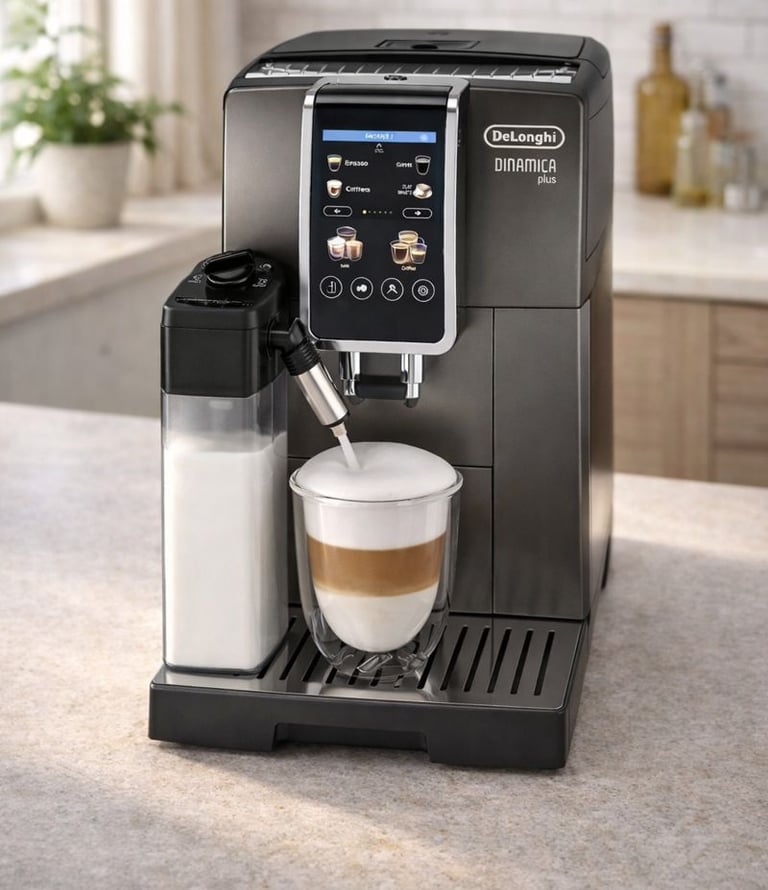
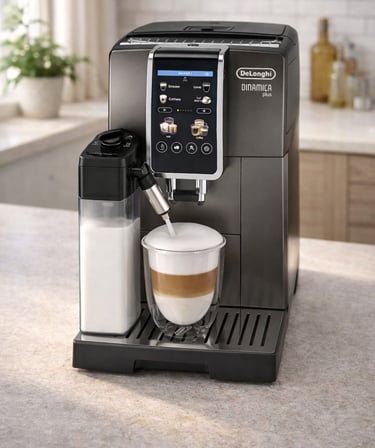
The Dinamica Plus has established itself as the preferred choice for homes where multiple people consume coffee with different preferences. The personalised user profiles and intuitive interface highlight this model in the competitive mid-to-high range segment.
Main features:
Monochrome backlit LCD display
6 customisable user profiles
Automatic LatteCrema system
Quiet ceramic grinder
24 integrated recipes
Ground coffee compartment
Water tank: 1.8 litres
"Iced coffee" function
The ground coffee compartment allows for the occasional addition of decaffeinated coffee without emptying the main bean container, a useful feature for nighttime consumption or when hosting guests with different preferences.
The profile system remembers up to 6 complete settings (type of drink, intensity, quantity, temperature), ideal for large families. Each user accesses their profile through simple navigation in the menu, eliminating the need to reconfigure settings daily.
The "iced coffee" function optimises extraction for preparation over ice. The equipment automatically adjusts intensity and temperature, compensating for the dilution that occurs when hot coffee contacts ice. The result: balanced cold beverages without a watery taste.
Ideal for: Large families, homes with mixed consumption (normal/decaffeinated), users who enjoy iced coffee, environments with multiple preferences.
Approximate price: £600-£800
6. De'Longhi La Specialista Arte
La Specialista Arte represents a completely distinct philosophy: a semi-automatic machine designed for users who wish to actively engage in the preparation, controlling every variable of the process. This equipment is aimed at enthusiasts willing to develop barista skills.
Main features:
Smart Tamping System (assisted and consistent tamping)
My LatteArt Sensor (milk temperature control)
Integrated grinder with 8 dedicated levels
Pre-infusion system
Professional 58mm portafilter
3 temperature settings
Analog pressure gauge
Power: 1450W
The Smart Tamping system revolutionises coffee tamping. Pressure sensors ensure uniform compaction of 10kg — the ideal pressure for balanced extraction — eliminating the main variable that compromises home extractions. Beginner baristas achieve consistent results from their very first attempts.
The My LatteArt sensor monitors milk temperature during steaming, signalling the optimal range (60-65°C) via an LED indicator. This functionality removes uncertainty from the process, allowing for professional milk texturing without an external thermometer.
The professional 58mm portafilter — standard in commercial machines — accepts universal tampers and allows advanced techniques such as WDT (Weiss Distribution Technique). Enthusiasts appreciate this compatibility with professional accessories.
Ideal for: Aspiring baristas, enthusiasts who value the manual process, pure espresso lovers, users willing to invest time in learning.
Approximate price: £475-£650


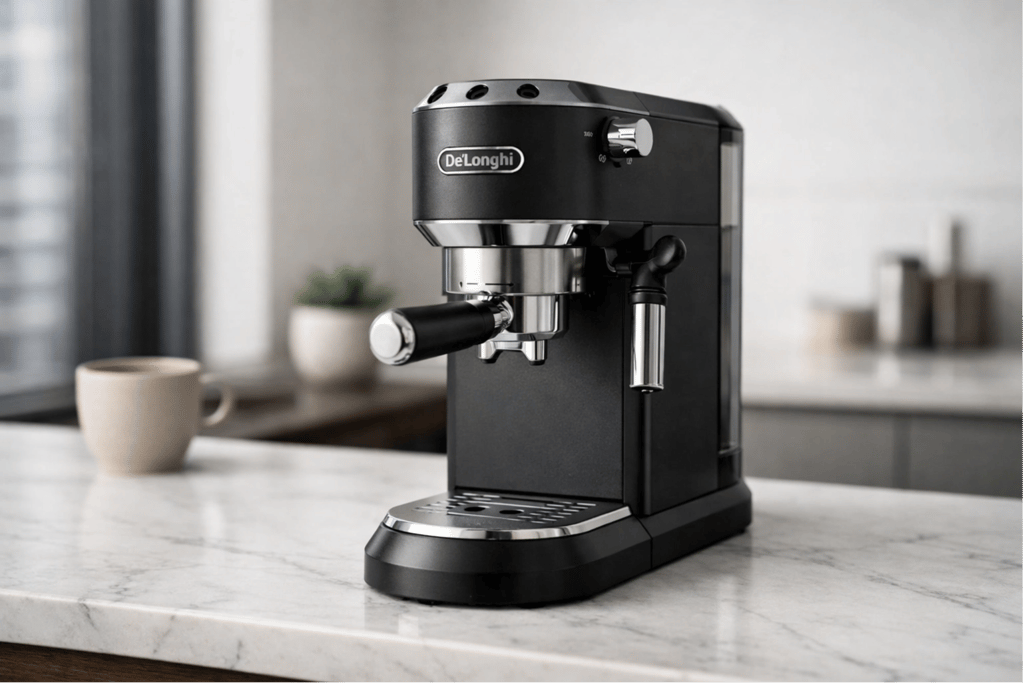
7. De'Longhi Dedica
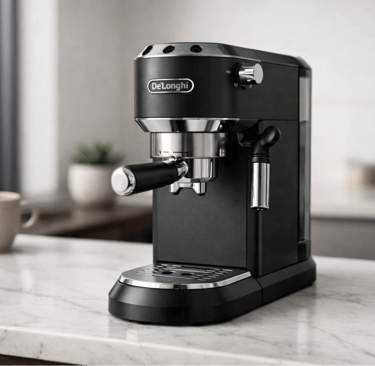
The Dedica has achieved iconic status due to its combination of ultra-compact design, solid performance, and affordable price. With just 15cm in width, it represents an ideal solution for small spaces without compromising extraction quality.
Main Features:
Width of only 15cm
Fast heating Thermoblock system
3 programmable buttons
Adjustable manual frother
Portafilter for ground coffee and E.S.E pods
Pressure: 15 bar
Water tank: 1 litre
Power: 1350W
Extreme compactness does not sacrifice essential components. The Thermoblock system heats water in 40 seconds, allowing you to prepare espresso quickly after turning on the machine—a significant advantage in fast-paced morning routines.
The portafilter accepts pre-ground coffee or E.S.E (Easy Serving Espresso) pods, offering flexibility for users without a dedicated grinder or those who value the convenience of pre-measured doses. The included pressurised filter generates consistent crema even with imperfect technique.
The manual frother, although basic, produces satisfactory foam after some practice. The movable tip makes it easy to position for different jug heights, an ergonomic detail appreciated in everyday use.
Ideal for: Compact spaces (flats, offices), students, second homes, users with a separate grinder, those who value minimalism.
Approximate price: £130-£190
Comparison table: key features
How to choose the ideal De'Longhi machine for you
The decision between models requires evaluating objective criteria aligned with consumption patterns, budget, and realistic expectations. This structured process eliminates post-purchase regrets.
1. Daily consumption volume
Automatic machines are better suited for consumption exceeding 3 coffees daily. The convenience of automatic preparation justifies investment when used frequently. For 1-2 coffees daily, semi-automatic models like Dedica offer better cost-benefit relations.
Families with 4+ members significantly benefit from models with personalised profiles (Dinamica Plus) or consecutive rapid preparation (Rivelia). Larger reservoirs (1.8L) avoid multiple fillings during peak consumption times.
2. Drink preferences
Consumers exclusively enjoying espresso or long coffee may choose simpler models (Magnifica S, Magnifica Start). Fans of cappuccinos, lattes, and flat whites greatly benefit from automatic LatteCrema systems (Magnifica Evo, Rivelia, Dinamica Plus), eliminating the learning curve of manual steaming.
Enthusiasts of cold beverages should primarily consider Rivelia, the only option with a dedicated system for iced preparations. Models without this functionality produce inferior results when extracting directly over ice.
3. Available space
Accurately measure the space allocated for the equipment. Consider not just the front width but also the depth and the necessary overhead space for filling water and bean reservoirs. Dedica (15cm) and Rivelia (24cm) stand out for their compactness. Traditional models require 30-35cm in width.
Plan space for cups, milk jug, and adjacent accessories. Machines perform better when positioned with 10-15cm free on each side for adequate ventilation.
4. Desired level of involvement
Users who value absolute convenience should prioritise automatics with fixed units and automatic cleaning systems (Magnifica Start, Magnifica Evo). Those who appreciate involvement in the process and tolerate manual maintenance find satisfaction in semi-automatics (La Specialista Arte, Dedica).
The choice between automatic and semi-automatic fundamentally defines the daily experience. Automatics prioritise consistency and speed; semi-automatics offer control and artisanal involvement.
5. Realistic budget
Establish a budget including essential accessories: dedicated grinder for semi-automatics (£40-£120), descaler (£12-£20 annually), cleaning tablets (£17-£25 annually). The initial investment represents only 70-80% of the total cost of ownership in the first year.
More expensive machines generally present a lower cost per coffee over 5 years due to greater durability and efficiency. Life cycle studies demonstrate that premium equipment reaches break-even against basic models after 18-24 months of intensive use[4].
Common mistakes when buying a De'Longhi machine (and how to avoid them)
Mistake 1: Underestimating the importance of bean quality
Machines costing £1,000 do not make up for oxidised supermarket beans. The quality of the coffee represents 60-70% of the final result in the cup, while the equipment contributes 30-40%[4]. Invest proportionally in fresh beans roasted within a maximum of 4 weeks from specialised suppliers.
How to avoid: Set aside 20-30% of the machine's budget for a regular supply of quality coffee. Test different origins and roast profiles to identify personal preferences.
Mistake 2: Ignoring maintenance requirements
Automatic machines require a rigorous cleaning routine. Neglecting descaling (every 2-3 months) and internal cleaning (weekly) reduces lifespan by 40-50% and progressively compromises flavour. Accumulated oily residues transfer bitterness to all extractions.
How to avoid: Set a maintenance calendar on your smartphone. Acquire cleaning tablets and descaler immediately after buying the machine. Consider maintenance costs (£60-£80 annually) in your overall budget.
Mistake 3: Choosing based solely on price
The cheapest model rarely constitutes the best choice in the medium term. Entry-level machines with inferior components often require replacement after 2-3 years, while mid-range equipment maintains performance for 5-7 years. The cost per coffee may be lower in seemingly more expensive models.
How to avoid: Calculate the estimated cost per coffee over 5 years, including maintenance and potential replacement. Compare this figure with the cost of frequented cafés to assess the real return on investment.
Mistake 4: Not testing preferences before purchase
Buying a machine without trying out the drinks it produces often leads to disappointment. The taste of espresso from an automatic differs significantly from that of a semi-automatic, even using the same beans. Foam textures vary dramatically between manual and automatic systems.
How to avoid: Visit specialist shops with demonstration areas. Ask to test models you are considering by preparing drinks you usually consume. Some retailers offer a home trial period (14-30 days).
Mistake 5: Disregarding compatibility with local water
Hard water (rich in minerals) accelerates limescale formation, requiring more frequent descaling. De'Longhi machines include hardness indicators, but many users ignore this initial setting.
How to avoid: Test water hardness with strips included in the packaging. Set the correct level in the machine's menu. Very hard waters (>20°dH) may benefit from a dedicated filter installed in the tank (£15-£25).
Mistake 6: Inadequately positioning the machine
Excessive proximity to walls prevents adequate ventilation, causing overheating. Positioning under upper cabinets makes it difficult to fill tanks. Being too far from the tap complicates frequent fillings.
How to avoid: Leave at least 10cm on the sides and 15cm above. Position close to a tap (2-3 metres distance ideal) and a dedicated socket. Avoid areas with direct sunlight, which can damage plastic components.
Maintenance and essential care
Daily routine (after each use)
Empty the drip tray and the drip tray. Rinse the coffee group in models with a removable unit. Clean the steam nozzle with a damp cloth immediately after frothing milk, preventing the build-up of dairy residues that harden quickly.
These simple actions, taking less than 2 minutes daily, prevent 80% of the technical issues reported in technical support[5].
Weekly routine
Run the automatic cleaning cycle with a specific tablet. Remove and wash the infusion unit (applicable models) with running water, without detergents. Dry completely before reinstalling. Clean the bean container, removing oily residues that oxidise and transmit rancidity.
Check the hardness level of the water in the tank using a visual indicator. Treated waters often deposit invisible minerals that accumulate progressively.
Monthly routine
Descale following the procedure in the manual, using only De'Longhi descaler or recommended products. Generic solutions can damage internal components. The complete process takes 30-45 minutes and should be carried out without interruptions.
Inspect the seals of the infusion unit, replacing them if they show visible wear (cracks, loss of elasticity). Compromised seals cause leaks and compromise extraction pressure.
Semi-annual routine
Replace the water filter (if applicable). Check the wear of the grinder by observing the consistency of grinding — significant variations indicate the need for calibration or replacement of the burrs. Schedule professional maintenance to lubricate internal components and check calibrations.
Frequently Asked Questions
1. What is the difference between automatic and semi-automatic machines?
Automatic machines grind beans, compact coffee, and extract automatically at the push of a button, controlling the whole process. Semi-automatics require manually loading the portafilter, tamping the coffee, and controlling extraction time, offering greater control but demanding skill. Automatics prioritise convenience; semi-automatics offer artisan involvement and extreme customisation.
2. Do I need to buy a separate grinder for the Dedica?
Yes, the Dedica does not include a built-in grinder and requires pre-ground coffee or E.S.E. pods. For ideal results, acquire a dedicated burr grinder (£42-£126) that allows you to adjust the grind size. Grinding just before extraction preserves 90% of the volatile aromas lost in pre-ground coffee after 30 minutes of exposure to air.
3. How often should I descale the machine?
The frequency depends on the hardness of the local water: soft water (0-7°dH) requires descaling every 4-5 months, medium water (8-14°dH) every 2-3 months, and hard water (15-21°dH) monthly. De'Longhi machines automatically indicate the need for descaling through a warning light. Ignoring this alert reduces the equipment's lifespan by 40-60%.
4. Can I use pre-ground coffee in automatic machines?
Yes, all De'Longhi automatics include a compartment for pre-ground coffee, useful for occasional decaf doses without emptying the bean container. However, fresh ground coffee provides superior flavour — a difference easily noticeable even by untrained palates. Reserve pre-ground coffee for exceptional situations.
5. Do LatteCrema systems produce foam equivalent to a manual steamer?
LatteCrema systems produce consistent, creamy foam, suitable for 90% of users. Experienced baristas can achieve slightly superior textures with manual steamers through advanced techniques, but the difference is marginal. For home use, LatteCrema offers an excellent convenience-quality ratio without a learning curve.
6. How long do ceramic grinders last?
De'Longhi ceramic grinders maintain consistent performance for 50,000-100,000 grinding cycles, equivalent to 7-12 years of average home use (2-3 coffees daily). Ceramic does not oxidise, grinds silently, and does not overheat beans, preserving aromas. Wear is gradual and generally imperceptible until the later stages.
7. Is it worth investing in models with connectivity?
Connectivity via app offers convenience (start preparation remotely, receive maintenance alerts) but does not improve coffee quality. Value this feature if you appreciate integrated technology and home automation. Machines maintain full functionality without a smartphone — the app is a complement, not a requirement.
8. What is the electrical consumption of these machines?
De'Longhi machines consume 1350-1450W during heating and extraction (2-3 minutes), then reduce to 5-10W on standby. Average monthly consumption for 2 coffees daily is approximately 3-5 kWh, equivalent to £0.80-£1.20 in the UK (considering £0.25/kWh). Energy-saving mode reduces standby consumption by 30-40%.
9. Do De'Longhi machines accept capsules?
No, the analysed machines exclusively use coffee beans or pre-ground coffee (and E.S.E. pods in specific models). This limitation is simultaneously an advantage: coffee beans offer better quality, lower cost per serving (£0.12-£0.25 vs £0.30-£0.40 for capsules), and significantly reduced environmental impact.
10. How do I know if I need to replace the brewing unit?
Brewing units last 5-7 years with proper maintenance. Signs of wear include: visible water leaks during extraction, excessively watery coffee even with maximum strength settings, unusual noises during cycles, difficulty in removing/reinstalling the unit. Replacement costs £68-£126 depending on the model.
11. Do machines make coffee as good as a café?
Well-maintained and properly operated home machines produce coffee comparable to average cafés, especially premium models (Rivelia, La Specialista Arte). Specialist cafés maintain an advantage in absolute consistency and advanced barista techniques, but the difference has drastically reduced with technological evolution over the last 5 years.
12. Can I leave water in the tank between uses?
Yes, but refresh the water if the machine is inactive for 3+ days to avoid bacterial proliferation and stagnant flavour. De'Longhi tanks include antibacterial treatment, but stagnant water accumulates impurities. Completely empty the tank if absent for more than a week.
Conclusion: which De'Longhi machine to buy in 2026
The choice of the ideal machine fundamentally depends on aligning technical characteristics with real usage patterns and realistic expectations.
For absolute beginners on a limited budget, the Magnifica Start offers uncomplicated initiation, allowing familiarisation with automatic preparation before any future upgrade. Minimum initial investment with proven De'Longhi quality.
Intermediate users who value a balance between features and price will find the Magnifica Evo a complete proposition: the LatteCrema system eliminates the learning curve of steaming, and the touch interface simplifies operation, while the app adds modern convenience. Represents a purchase for 5-7 years without the need for an upgrade.
Large families or environments with diverse consumption greatly benefit from the Dinamica Plus. Individualised profiles, a double bean container, and quick consecutive preparation justify the higher investment when multiple people use the equipment daily.
Diligent enthusiasts willing to invest in high-end models will find the Rivelia state-of-the-art technology: the Bean Adapt guarantees optimised extractions automatically, the Hot & Cool system expands possibilities for cold beverages, and the compact design is surprising for its technological density. A choice for those who prioritise technical excellence.
Aspiring baristas who value the artisanal process and total control should consider the La Specialista Arte. Smart Tamping removes the primary technical difficulty, the My LatteArt sensor guides steaming, and the professional portafilter allows gradual evolution of skills. Investment in learning, not just equipment.
For ultra-compact spaces where every centimetre counts, the Dedica has no rival: 15cm wide, fast heating, and robust construction at an affordable price. Requires a separate grinder but compensates with the freedom of positioning that compactness provides.
Regardless of the model chosen, investing in a De'Longhi machine represents substantial savings compared to consumption in cafés (typical break-even in 4-8 months) and, more importantly, total control over the quality and freshness of the coffee consumed daily.
👉 Compare all De'Longhi models on Amazon and choose the ideal one for you
References
[1] Durability of ceramic grinders
Source: JavaPresse Coffee Company (2024)
Link: https://www.javapresse.com/blogs/grinding-coffee/how-long-do-coffee-grinder-burrs-last
Fact: Ceramic grinders last 750-800 lbs of coffee (equivalent to ~10 years of average domestic use)
[2] Grinding consistency
Source: Journal of Food Process Engineering (2025) - Khongphinitbunjong et al.
Link: https://onlinelibrary.wiley.com/doi/10.1111/jfpe.70129
Fact: Scientific study on particle distribution and grinding consistency
[3] Total cost of ownership
Source: SimplyCodes (2025)
Link: https://simplycodes.com/blog/coffee-maker-cost-comparison-guide
Fact: Detailed analysis of ownership costs over 5 years for different types of machines
[4] Variables in extraction quality
Source: Perfect Daily Grind (2021)
Link: https://perfectdailygrind.com/2017/12/a-guide-to-coffee-grind-size-consistency-flavor/
Fact: Technical guide on the impact of grind size on quality
[5] Causes of breakdowns
Source: KLLR Coffee
Link: https://kllrcoffee.com/blogs/kllr-coffee-blog/how-often-should-i-change-my-burrs
Fact: Analysis on maintenance and common causes of wear
[6] Aroma degradation
Source: ScienceDirect (2025)
Link: https://www.sciencedirect.com/science/article/pii/S0963996925023658
Fact: Peer-reviewed scientific study on the loss of volatile compounds in ground coffee
Contact
Contact us for questions or suggestions.
© 2026. All rights reserved.
Information