


French Press: A Complete Guide to Making the Perfect Coffee at Home
The French press is one of the most popular and accessible coffee extraction methods in the world, capable of producing a full-bodied, aromatic drink full of flavor with minimal equipment and simple techniques. If you are looking for a coffee with a dense body, preserved natural oils and complex notes without needing expensive machines or advanced skills, this guide will teach you everything you need to know to master this classic method — from selecting the beans to the fine adjustments that transform an ordinary coffee into an exceptional one.
What is a French Press and How Does It Work
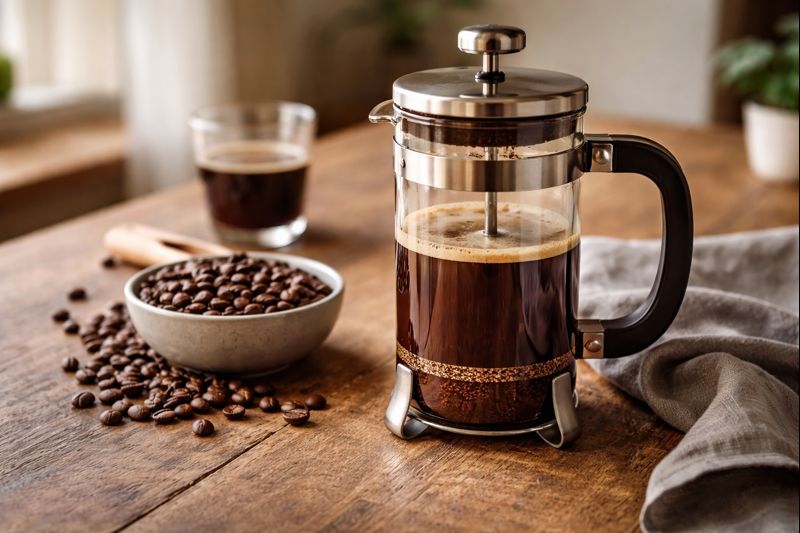
The French press, also known as a plunger pot or French press coffee maker, is an immersion brewing device invented in France in the 19th century. It consists of a cylindrical container (usually made of glass) with a metal plunger that has a fine mesh filter, allowing the ground coffee to stay in direct contact with hot water for several minutes before being separated by pressure.
Principle of Operation
Unlike drip methods where water quickly passes through the coffee, the French press works by full immersion: the grounds remain submerged in water for 4 minutes, extracting oils, sugars, and aromatic compounds evenly. The metal mesh filter lets the natural oils from the coffee pass through (which would be trapped in paper filters), resulting in a beverage with a denser body and richer texture.
Main Components
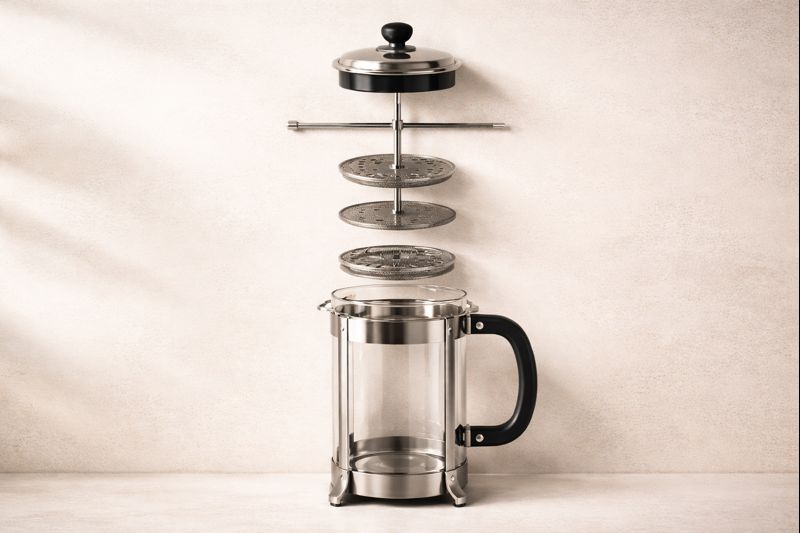
Carafe: Typically made of heat-resistant borosilicate glass, but also available in stainless steel
Plunger: Metal rod with a perforated disk that pushes the coffee down
Filter: Stainless steel mesh with multiple layers
lid: With an opening to pour coffee without fully removing it
Why Choose the French Press
Advantages of the Method
Superior Body and Texture The absence of a paper filter allows the natural oils of the coffee to pass into the cup, creating a drink with a velvety body and rich texture that filtered methods cannot replicate. These oils carry complex flavors and provide that creamy sensation in the mouth.
Simplicity and Accessibility No electricity, expensive machines, or barista skills are needed. With a French press (€15-50), a grinder, and hot water, anyone can make excellent coffee at home or while traveling.
Total Control of the Process You can adjust all parameters — amount of coffee, water temperature, extraction time — to completely personalize the final flavor to your preference.
Versatility In addition to coffee, you can use the French press to prepare tea, make cold brew, or even froth milk manually.
Disadvantages to Consider
Sediment at the Bottom Even with a quality filter, small coffee particles reach the cup, especially in the last sips. This is normal, and many enthusiasts appreciate this characteristic, but it may bother those who prefer completely clean coffee.
Requires Attention to Time Exceeding the extraction time results in bitter and over-extracted coffee. You need to be present during the 4 minutes of preparation.
More Laborious Cleaning Compared to capsule methods, the French press requires disassembly and careful cleaning after each use to avoid the buildup of rancid oils.
Necessary Equipment
Essential
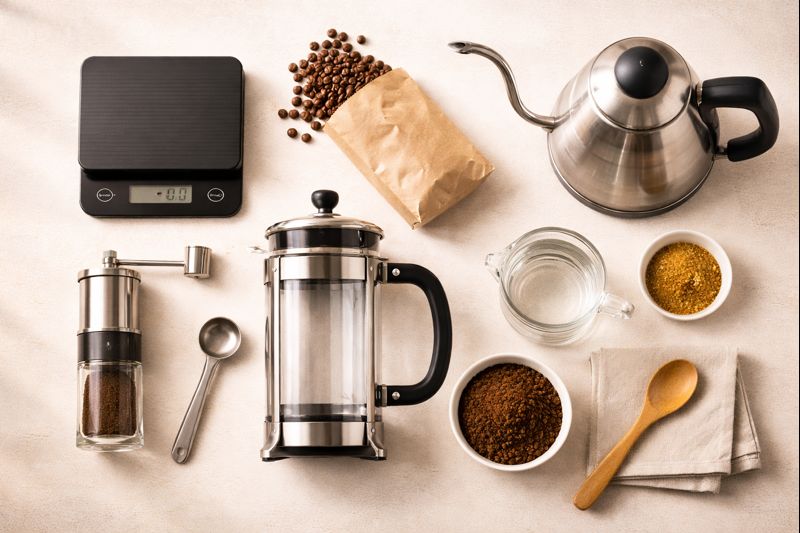
French Press (0.35L to 1L) For individual use, 0.35-0.5L is ideal. For 2-3 people, choose 1L. Recommended brands: Bodum Chambord, Bialetti, Hario. Prefer double borosilicate glass for better temperature retention.
Coffee Grinder Absolutely essential. Pre-ground coffee oxidizes quickly and compromises flavor. A burr grinder (Baratza Encore, Hario Skerton, Timemore C2) allows you to control the grind size. Blade grinders work but produce inconsistent particles.
Digital Scale A precision of 0.1g ensures consistency. Basic models cost €10-15 and make all the difference.
Kettle With a narrow spout for pouring control. If it has a built-in thermometer, even better for monitoring temperature.
Timer The smartphone works perfectly. Timing precision is critical.
Optional but Recommended
Digital Thermometer: To control the water temperature (ideal: 92-96°C)
Measuring Spoon: To transfer ground coffee
Separate Pitcher: To transfer the coffee after extraction and avoid over-extraction
Choice of the Ideal Coffee
Type of Bean
Arabica vs Robusta Prefer 100% Arabica for more complex flavours and balanced acidity. Robusta tends to be more bitter and less aromatic, although it works in specific blends for those who enjoy very strong coffee.
Single Origin vs Blend Single origins (Ethiopia, Colombia, Brazil) allow exploration of distinct flavour profiles. Balanced blends work well for daily use.
Roast Level
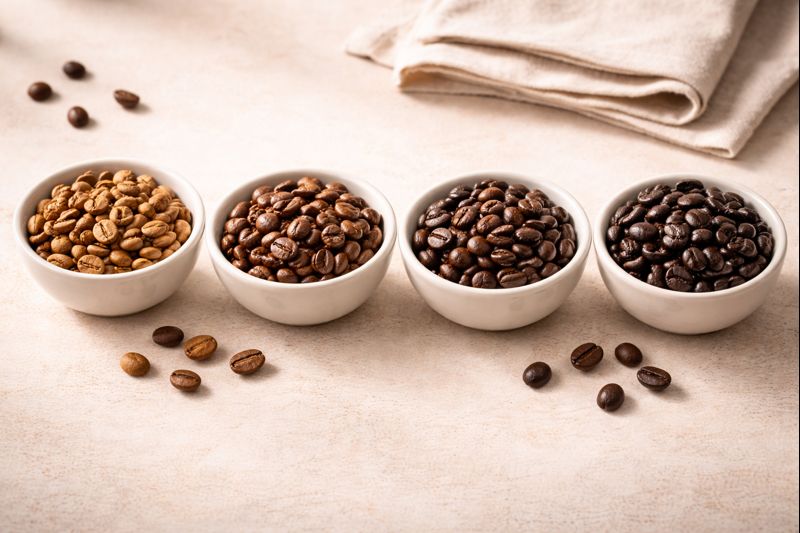
Light to Medium Roast Preserves vibrant acidity and floral/fruity notes. Ideal for high-quality single origin coffees. Requires slightly hotter water (94-96°C).
Medium-Dark Roast Balances acidity with chocolate and caramel notes. The most versatile choice for a French press, pleasing the majority of tastes.
Dark Roast Robust flavours of bitter chocolate, roasted nuts, and low acidity. Works well but may become bitter if over-extracted. Use water at 90-92°C.
Freshness
Buy coffee roasted less than 30 days ago. After opening, consume within 2-3 weeks. Store in an airtight container, away from light and heat. Never in the fridge — condensation can ruin the flavour.
The Perfect Grind for French Press
Correct Granulometry
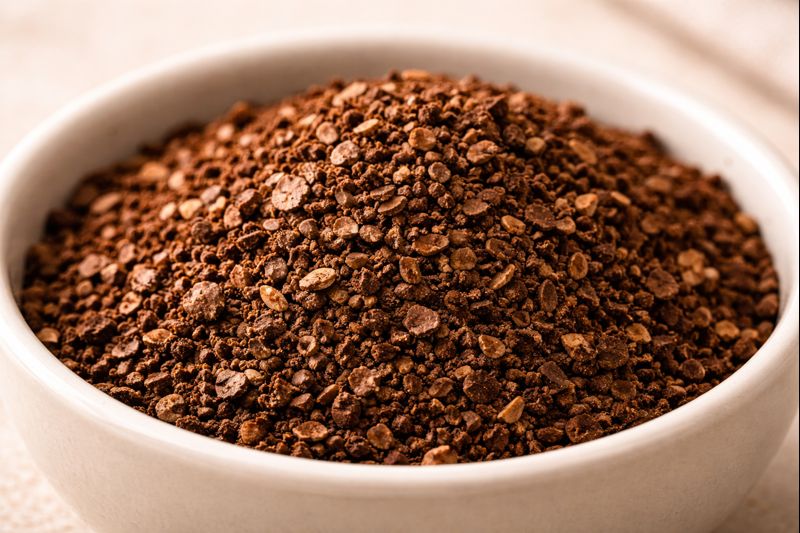
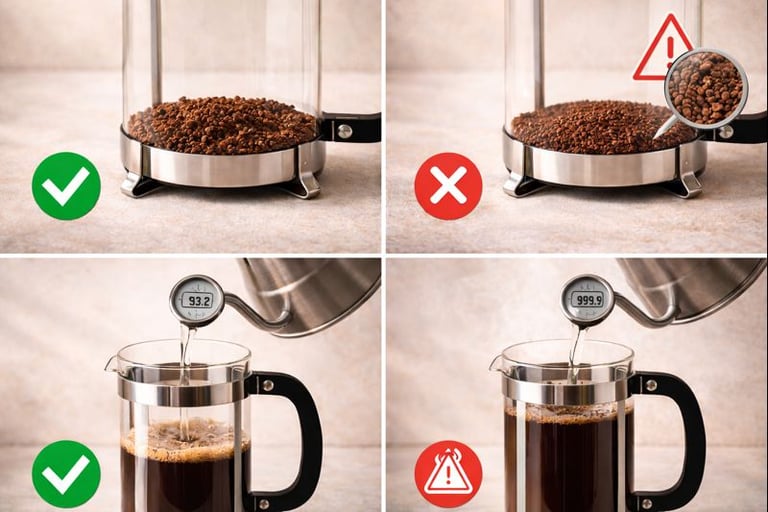
The grind for French press should be coarse, similar to coarse sea salt or breadcrumbs. Very fine particles pass through the metal filter, creating excessive sediment and bitter over-extraction. Very coarse particles result in under-extraction and weak coffee.
Visual Test: When rubbing the ground coffee between your fingers, you should feel distinct individual grains, not a uniform powder.
Consistency is Key
Burr grinders produce uniform particles, essential for balanced extraction. Blade grinders create a mix of fine powder and large chunks— the fine particles over-extract (bitterness) while the large pieces under-extract (watery acidity).
Grind Immediately Before Brewing
Ground coffee starts to lose its aromas within minutes. Grinding immediately before preparation maximises freshness and aromatic complexity. The difference is dramatic.
How to Make Coffee in a French Press (Step by Step)
Coffee:Water Ratio
Standard Ratio: 1:15 to 1:16
15g of coffee for 250ml of water (1:16.6) — balanced profile
20g of coffee for 300ml of water (1:15) — fuller-bodied
30g of coffee for 500ml of water (1:16.6) — for 2 people
Adjust according to preference. Prefer strong coffee? Use 1:13. Like it milder? Use 1:17.
Water Temperature
Ideal: 92-96°C
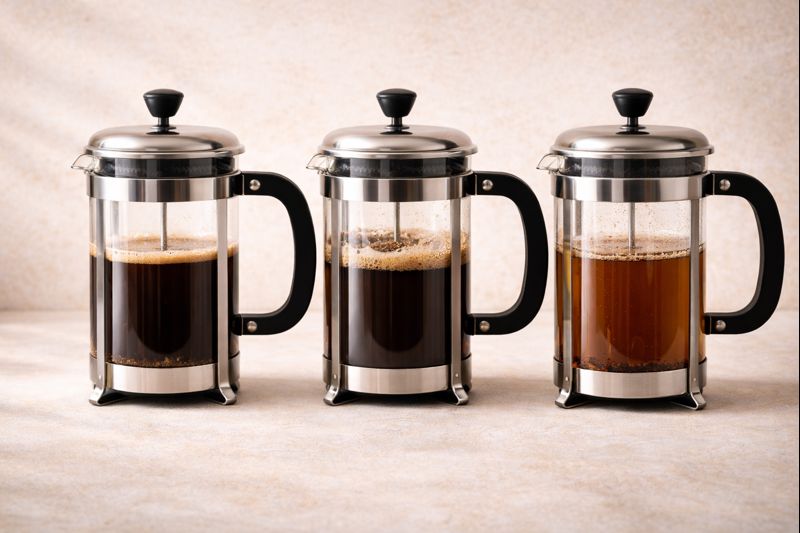
If you don’t have a thermometer, let the water boil and wait 30-60 seconds before using. Water that is too hot (>96°C) extracts undesirable bitter compounds. Cold water (<90°C) results in acidic under-extraction.
Complete Procedure
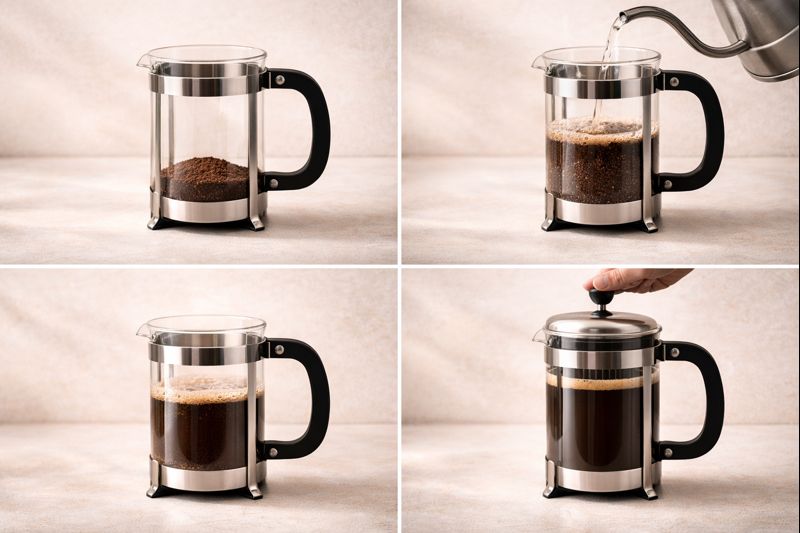
1. Heat the Press (30 seconds) Fill with hot water and let it warm while you prepare the rest. Discard the water before use. This keeps the temperature stable during extraction.
2. Measure and Grind (1 minute) Weigh 15g of coffee for every 250ml of water you will use. Grind to a coarse consistency just before preparing.
3. Add Coffee to the Press Pour the ground coffee into the heated press. Gently shake to level the bed.
4. Bloom / Pre-infusion (30 seconds) Pour enough water to completely cover the coffee (about 50ml). Let it rest for 30 seconds. You will see the coffee expand and release CO₂. This step significantly improves extraction.
5. Add Remaining Water (30 seconds) Pour the remaining water in a circular motion, ensuring all the coffee is submerged. Place the lid with the plunger raised.
6. Extraction / Immersion (4 minutes) Start the timer. Do not stir, do not shake. Let time do the work. At exactly 4 minutes, it’s ready.
7. Break the Crust (15 seconds) With a spoon, gently push down the layer of coffee floating on the surface. This releases intense aromas and allows the grounds to settle.
8. Press the Plunger (20 seconds) Press down slowly and evenly. If you feel a lot of resistance, the grind is too fine. Stop when you reach the bottom — do not force it.
9. Serve Immediately Transfer the coffee to a jug or serve directly. Leaving it in the press continues to extract and makes the coffee bitter.
Total Time: ~6-7 minutes
Variations and Advanced Techniques
James Hoffmann Method (Less Sediment)
Normal preparation for up to 4 minutes
Do not press immediately — remove the crust with a spoon and discard the foam
Wait an additional 5-8 minutes for the coffee to settle naturally
Press gently only to the level of the liquid (not all the way to the bottom)
Result: much cleaner coffee with less sediment
Cold Brew in a French Press
Ratio: 1:8 (100g coffee / 800ml cold water)
Grind: Medium-coarse
Leave in the press at room temperature or in the fridge for 12-16 hours
Press and dilute with water or milk to taste
Keeps for 5-7 days in the fridge
Adjustments by Roast Profile
Light Roast: 96°C, 4:30 minutes, ratio 1:16 Medium Roast: 94°C, 4:00 minutes, ratio 1:15 Dark Roast: 92°C, 3:30 minutes, ratio 1:14
Common Errors and How to Avoid Them
1. Excessively Fine Grinding
Symptom: Very bitter coffee, excessive sediment, difficult to press the plunger Solution: Adjust the grinder to a coarser setting. The coffee should have a texture like coarse salt, not fine sand.
2. Boiling Water (100°C)
Symptom: Burnt flavour, intense bitterness, loss of subtle notes Solution: Allow the water to cool for 30-60 seconds after boiling. Invest in a thermometer or kettle with temperature control.
3. Inconsistent Extraction Time
Symptom: Unpredictable flavour — sometimes strong, sometimes weak Solution: Always use a timer. 4 minutes is the standard. Variations of 15-30 seconds make a significant difference.
4. Leaving Coffee in the Press After Brewing
Symptom: Last cups much more bitter than the first Solution: Transfer immediately to a thermos or jug. Coffee in the press continues to extract indefinitely.
5. Pre-Ground or Old Coffee
Symptom: Flat flavour, lacking complexity, no aroma Solution: Buy freshly roasted coffee beans that have been roasted for less than 30 days. Grind immediately before brewing.
6. Not Heating the Press
Symptom: Coffee loses temperature quickly, uneven extraction Solution: Always pre-heat with hot water before adding the coffee.
7. Pressing the Plunger Too Quickly
Symptom: Murky coffee, sediment in suspension, muddy flavour Solution: Press slowly and evenly over 20-30 seconds. Let the filter do the work.
8. Inadequate Cleaning
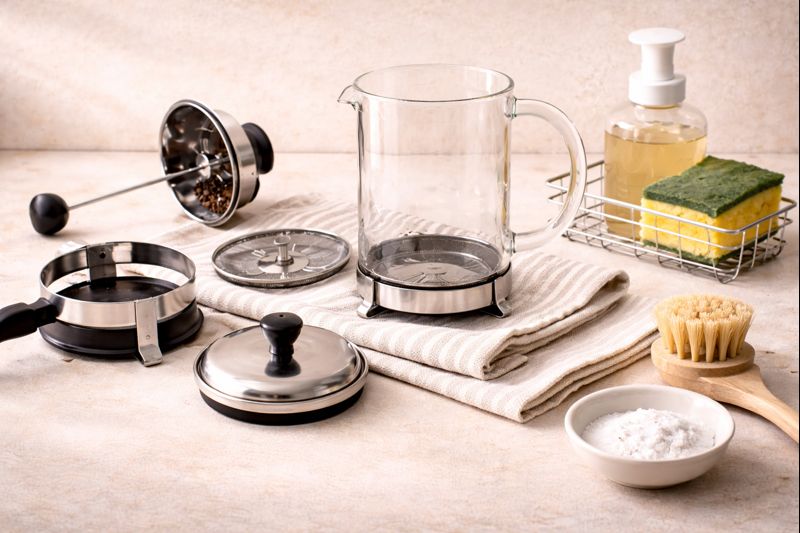
Symptom: Rancid flavour, old oils contaminating new brews Solution: Disassemble completely after each use. Wash all components with hot water and detergent. Dry thoroughly.
Cleaning and Maintenance
Daily Cleaning (After Each Use)
Dispose of the used grounds — Turn the press over the bin or compost. Avoid disposing through the drain (clogs plumbing).
Dismantle the plunger — Separate the lid, filter, and discs. Many models unscrew easily.
Wash with hot water and detergent — Use a soft sponge. Do not use steel wool as it damages the glass.
Rinse thoroughly — Remove all detergent residue that affects flavour.
Dry completely — Especially the metal filter to avoid oxidation.
Deep Cleaning (Weekly)
Leave the metal components to soak in a solution of hot water with bicarbonate of soda (1 tablespoon per litre) for 15-30 minutes to remove accumulated oils
Brush the filter with a small brush to remove residue between the meshes
Check the rubber seal of the plunger — replace if cracked or deformed
Parts Replacement
Filter/Mesh: Replace annually or when noticing excessive sediment Rubber seal: Every 1-2 years or when it loses elasticity Glass jar: Immediately if cracked (risk of shattering during use)
Comparison with Other Methods
[IMAGE 11: Visual infographic comparing French press, V60 and espresso in terms of flavour, body and difficulty] ALT: Infographic comparison between French press and other coffee extraction methods
French Press vs V60
French Press: Dense body, preserved oils, rich texture, simple preparation, less clean V60: Clean and clear coffee, enhances acidity and subtle notes, requires more technique, no oils
Choose French Press if: you value body and convenience
Choose V60 if: you prefer clarity and enjoy experimenting with techniques
French Press vs Aeropress
French Press: Greater capacity (serves several people), extraction by passive immersion, traditional flavour Aeropress: Portable, versatile (many recipes), quicker (1-2 min), manual pressure
Choose French Press if: you regularly prepare for 2+ people
Choose Aeropress if: you travel frequently or want experimentation
French Press vs Espresso
French Press: Accessible equipment (£20-50), no learning curve, smooth coffee Espresso: Concentrated and intense coffee, expensive equipment (£300-2000), complex technique
Choose French Press if: you want simplicity and low cost
Choose Espresso if: you enjoy cappuccinos/lattes or very strong coffee
Buying Guide: Choosing the Best French Press
Materials
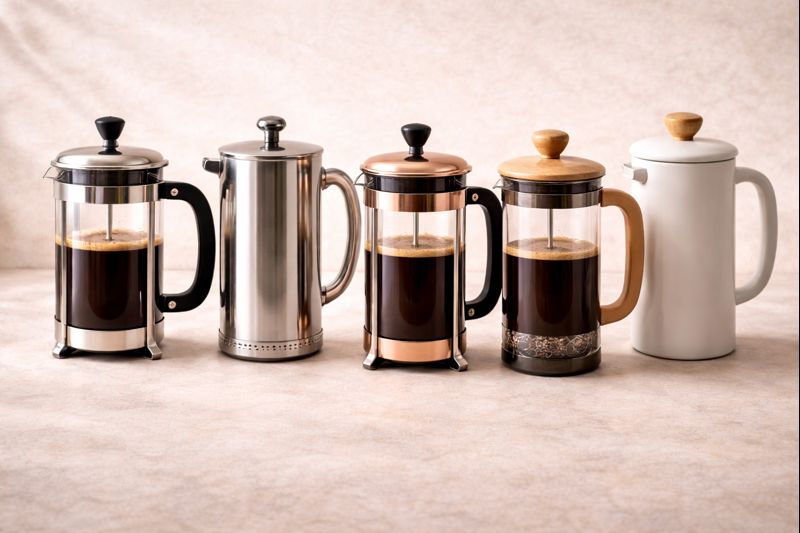
Borosilicate Glass The most common, allows you to see the process, neutral to flavour. Choose double-walled (Bodum Chambord) for better thermal insulation. Fragility is the downside.
Stainless Steel Indestructible, retains temperature for longer, ideal for travel. Does not allow for visibility of the extraction. Slightly more expensive.
Ceramic Excellent thermal retention, stylish, heavier. Less common, medium to high price.
Sizes
0.35L (3 small cups): Individual, ideal for testing or travel
0.5L (4 cups): 1-2 people, most versatile size
1L (8 cups): Families, offices, 3-4 people
1.5L+: Commercial use or large groups
Recommended Brands
Bodum Chambord (€30-50): Timeless classic, proven quality, replacement parts available
Bialetti Preziosa (€25-40): Italian design, good value for money
Espro P7 (€80-140): Patented double filter, minimal sediment, top of the range
What to Avoid
Presses under €15 — questionable filter and glass quality
Models without replacement parts available
Plastic in contact with hot coffee (BPA, altered flavour)
Frequently Asked Questions
How much coffee should I use in a French press?
Use 15-20g of coffee for every 250ml of water (ratio 1:15 to 1:16). For a stronger flavour, use up to 1:12; for a milder taste, up to 1:17. Begin with 15g for 250ml and adjust according to your personal preference. Consistency is more important than following exact numbers.
What is the ideal water temperature for a French press?
The ideal temperature is between 92-96°C. If you don't have a thermometer, allow the water to boil and wait 30-60 seconds before using. Water at 100°C burns the coffee and creates bitterness; below 90°C results in acidic under-extraction. The temperature dramatically affects the final flavour.
How long should I leave the coffee in the French press?
The standard time is exactly 4 minutes after adding all the water. Less time results in weak and acidic coffee; more time creates excessive bitterness. Use a timer for consistency. After pressing, transfer immediately to avoid continuous over-extraction.
Why does my French press coffee taste bitter?
Excessive bitterness usually indicates over-extraction caused by: too fine a grind, water that is too hot (>96°C), extraction time longer than 4-5 minutes, or coffee left in the press after brewing. Adjust the grind to coarser, reduce temperature, or contact time.
Can I use pre-ground coffee in a French press?
Technically yes, but it is not recommended. Pre-ground coffee loses aromas quickly and rarely has the ideal coarse grind for a press. If you don’t have a grinder, ask the store to grind specifically for a French press and use it within a few days. The difference in flavour between freshly ground and pre-ground is significant.
How can I avoid sediment at the bottom of the cup?
Some sediment is normal and expected in a French press. To minimise it: use a consistent and coarse grind, press the plunger very slowly, allow the coffee to settle for 1-2 minutes after pressing before serving, or try James Hoffmann's method, which drastically reduces sediment.
How many cups does a 1-litre press serve?
A 1L press produces approximately 4 cups of 250ml or 6-8 small espresso-style cups. In practice, it serves well for 2-3 people drinking standard cups. Remember never to fill completely to the top due to the volume of ground coffee.
Does the French press make stronger coffee than other methods?
The French press produces coffee that is more full-bodied due to the oils that pass through the metal filter, but it is not necessarily stronger in caffeine. The caffeine concentration depends on the ratio of coffee to water used. By allowing for a prolonged contact time, it extracts more compounds than quick-drip methods, resulting in a heartier flavour.
Do I need a specific grinder for French press?
You don’t need a specific grinder, but you do need a burr grinder that allows adjustment for a consistent coarse grind. Blade grinders create irregular particles that compromise extraction. Investing in a basic burr grinder (€30-50) makes more of a difference than buying an expensive press.
How do I clean accumulated oils in the French press?
To remove rancid oils: completely disassemble it, soak in hot water with baking soda (1 tablespoon/litre) for 30 minutes, scrub with a brush, and rinse thoroughly. Do this weekly. Old oils contaminate the flavour of new coffee, so proper cleaning is essential for consistent quality.
Can I make tea in a French press?
Yes, the French press works excellently for loose leaf teas. Use 1 teaspoon per 250ml of water at 70-95°C (depending on the type of tea), steep for 3-5 minutes and press. It is perfect for teas that require multiple infusions. Rinse well between coffee and tea to avoid mixing flavours.
What is the difference between a French press and an Italian coffee maker?
The French press uses immersion extraction (coffee is submerged in water) producing a drink with body and oils. The Italian coffee maker (moka) uses steam pressure forcing water through the coffee, creating a more concentrated drink similar to espresso but less intense. The French press is smoother, the moka is stronger and more robust.
Conclusion: Is the French Press Worth It?
The French press remains relevant decades after its invention because it delivers what it promises: rich-bodied coffee with a full flavour using minimal equipment and accessible technique. For those who value convenience without sacrificing quality, appreciate dense textures and natural oils, or want to brew coffee for several people at once, it is an excellent and economical choice.
The initial investment is minimal (€20-50 for the press + €30-50 for a basic grinder), the learning curve is gentle, and the results are immediately satisfying. With practice and attention to detail — correct grind, appropriate temperature, precise timing — you can extract coffees that rival those from specialised cafés.
If you are starting to explore manual coffee methods, the French press is the ideal starting point: it teaches the fundamentals of extraction (ratio, temperature, time) without intimidating with complex techniques. As you develop your palate, you can experiment with fine adjustments and advanced variations.
Next Steps:
Choose a quality press suitable for your needs
Invest in a burr grinder (essential for good results)
Buy quality whole bean coffee, freshly roasted
Follow the base recipe and gradually adjust to your taste
Explore other methods like V60 or espresso when you master the press
The perfect coffee is just a few minutes away.
Additional Resources
Useful Tools:
Coffee and Water Calculator — Calculate exact proportions for any quantity
Related Articles:
Contact
Contact us for questions or suggestions.
© 2026. All rights reserved.
Information